
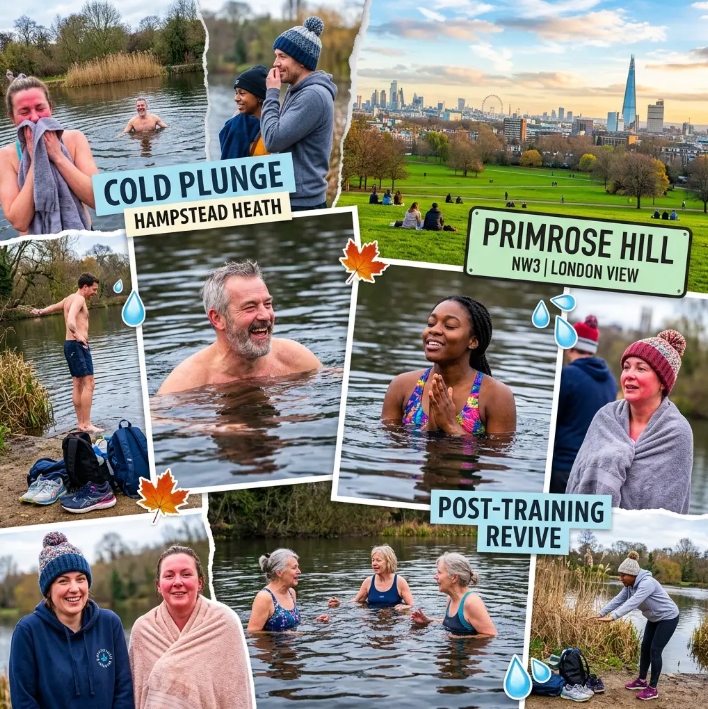
Cold plunging has become one of the most oversold protocols in modern fitness. Every podcast guest claims it changed their life. Every London gym now has a plunge pool. Every man in Hampstead with a garden has bought one.
Most people are using them wrong.
The research is actually quite clear on when cold plunging works and when it costs you, and the nuance matters if you care about your results.
The actual protocol
The dose response research is based on 2 things: temperature and total weekly exposure.
Temperature: 3 to 8 degrees Celsius. Anything warmer is a cold shower, not a cold
plunge. Anything colder and you’re risking cardiovascular events for no additional benefit.
Total weekly exposure: 11 minutes. This is the number from the Søberg protocol research, the only validated cold exposure dose for measurable metabolic and recovery adaptations.
Per session: 2 to 3 minutes, done across 3 to 5 sessions a week.
That’s the protocol. Everything else, such as 10 minute endurance challenges, daily plunging and
pre breakfast ice baths, is marketing.
Where most people get it wrong
The nuance everyone misses is when you cold plunge.
Inflammation is the biological signal your body uses to adapt to training. When you lift weights, you create microscopic damage in muscle fibres. Your body responds with an inflammatory cascade. That cascade is what triggers muscle growth, strength adaptation, and improved performance.
If you blunt that inflammatory signal, for example by plunging into 4 degree water immediately after a hypertrophy focused weights session, you blunt the adaptation.
The research is consistent. Cold water immersion within 4 to 6 hours of a strength session reduces muscle protein synthesis, reduces hypertrophy, and reduces long-term strength gains.
If your goal is building muscle, don’t cold plunge after you lift.
When cold plunging actually helps
3 scenarios where the recovery benefit outweighs the inflammatory cost:
1. Combat athletes training twice a day. If you’re doing a BJJ session in the morning and a strength session in the afternoon, soreness between sessions becomes the bottleneck. Cold plunging between sessions recovers you fast enough to train again. The trade off is worth it.
2. Endurance athletes in a heavy training block. Marathon training, cycling blocks, triathlon prep. You’re accumulating training volume, not chasing muscle growth. Cold plunging reduces perceived soreness and helps you absorb more training.
3. Anyone who needs to perform the next day. Tournament weekends, fight camps, high stakes competition. You’re prioritising readiness over long term adaptation.
For everyone else, meaning men lifting 3 or 4 times a week to build muscle and health, cold plunging after sessions is probably hurting your results.
The smart timing
If you want the metabolic benefits of cold exposure without the training interference, these are the right windows:
- First thing in the morning, well before you train
- On a rest day, with no training within 6 hours
- Mid morning on a training day, if you train in the evening
The cardiovascular and metabolic adaptations from cold exposure are real. Brown fat activation, dopamine response, improved insulin sensitivity and cardiovascular conditioning are all useful.
Just don’t take them at the expense of your training adaptations.
The honest take
Cold plunging is a tool, not a religion. Used correctly, it’s useful. Used wrong, it’s self sabotage.
The protocol: 3 to 8 degrees, 11 minutes per week, 2 to 3 minutes per session, 3 to 5 sessions. Away from your strength training sessions.
If you’re lifting 3 times a week to build muscle and you’re plunging immediately after every session, you’re paying for the protocol twice, once for the plunge and once in reduced results. At BTX in Hampstead, recovery protocols are personalised to each client’s training load, blood markers, and goals. If you want a protocol built around your actual biology, book a free strategy call at bodytransformationlondon.com.